Managing Emails with n8n, Ollama, Open WebUI, and Qdrant
After experimenting with autonomous MCP agents (like kagent with a Gmail MCP server) running against local LLMs in Ollama, I kept running into the same reliability wall: small-to-medium local models (8B–14B) struggle when asked to handle inbox polling, tool selection, JSON argument schemas, draft creation, and memory management all inside one open-ended agent loop.
I decided to split deterministic plumbing from probabilistic text generation using four services I already run (or can deploy cleanly) on my home Kubernetes cluster via ArgoCD:
- n8n (+ its bundled PostgreSQL) for deterministic Gmail polling, state tracking, and workflow orchestration
- Ollama (on an AMD GPU node) for local embeddings (
nomic-embed-text:v1.5) and drafting/triage (gemma4:12b) - Qdrant for long-term vector memory storing deduplicated drafting style and triage rules
- Open WebUI as the single human-in-the-loop chat interface (no Telegram, Slack, Mem0, or
gmail-mcpservers required)
Everything below is deployed 100% declaratively and idempotently via ArgoCD (including Qdrant collections, PostgreSQL tables, Open WebUI Pipe functions, n8n credentials, and workflows) so a full cluster reset requires zero manual setup.
Goal and Architecture
The workflow I wanted to build covers the full human-in-the-loop learning cycle:
- Monitor my Gmail inbox on a schedule (every 4 hours).
- Query long-term memory (Qdrant) before deciding what to do with each new email.
- Triage each message into one of three actions:
- Draft (
draft): Generate a tailored reply using learned style rules, create a Gmail draft on the thread, and notify me in Open WebUI. - Summarize only (
summarize_only): For ads, newsletters, and automated notifications, skip creating a Gmail draft and post a concise summary in Open WebUI. - Auto-trash (
auto_trash): Only when an explicit learned triage rule authorizes it, move the email to Gmail Trash (recoverable for 30 days) and still post a review chat in Open WebUI.
- Draft (
- Reply directly inside that Open WebUI chat to refine drafts in-place, trash/restore emails, or teach new style and content-conditional triage rules.
- Automatically extract only reusable rules (ignoring one-off edits like dates or meeting times), deduplicate them (
ADD/UPDATE/NOOP), and store them in Qdrant so future emails benefit immediately. - Post a lightweight heartbeat log to a single Open WebUI chat when a run completes with zero new emails, and immediately alert me in Open WebUI if any workflow node fails.
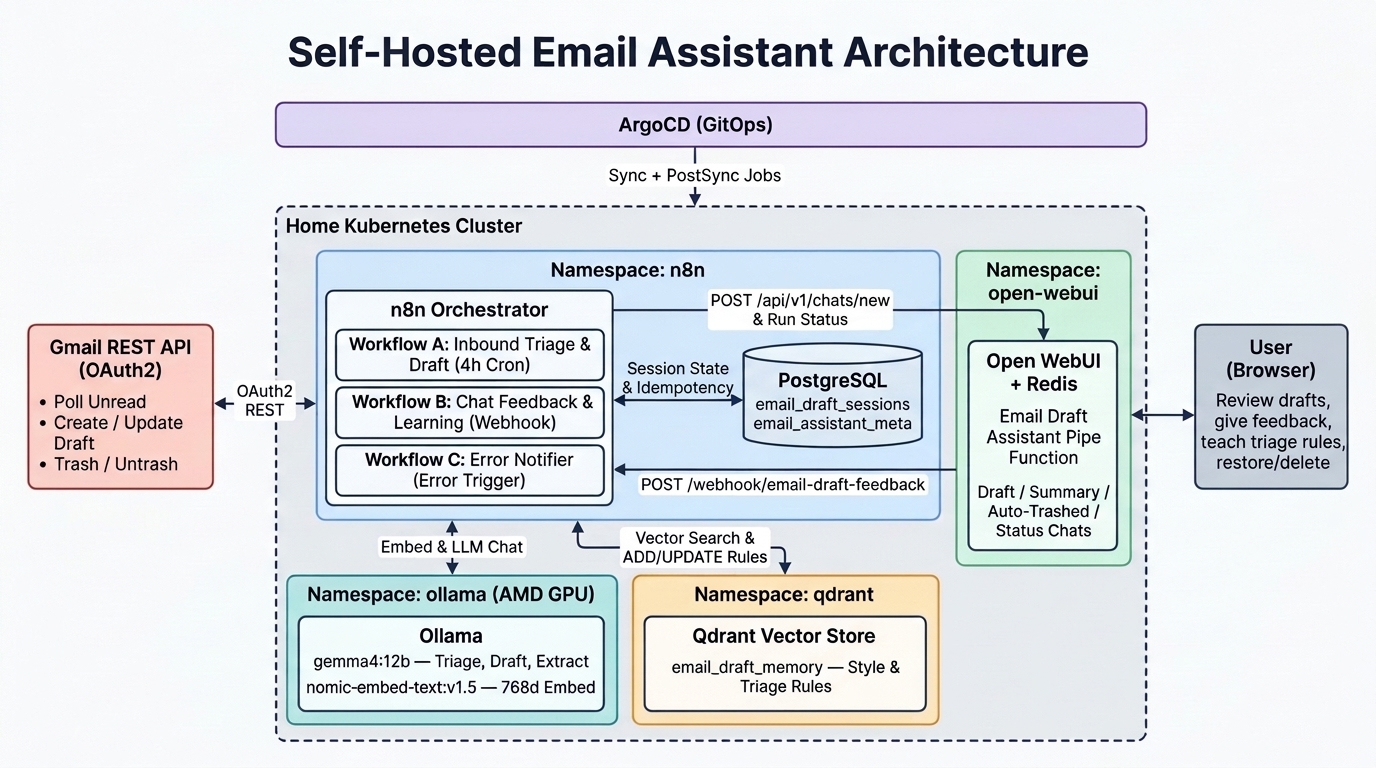
Component Layout in Kubernetes
Each service lives in its own namespace, managed by a separate ArgoCD Application using Kustomize + Helm (overlays/home):
| Component | Namespace | Internal Cluster Endpoint | External / Internal URL | Role |
|---|---|---|---|---|
| Ollama | ollama |
http://ollama.ollama.svc.cluster.local:11434 |
ollama.internal |
AMD GPU inference (gemma4:12b, nomic-embed-text:v1.5) |
| Qdrant | qdrant |
http://qdrant.qdrant.svc.cluster.local:6333 |
ClusterIP only | Long-term vector memory (email_draft_memory, 768-dim Cosine) |
| n8n + PostgreSQL | n8n |
http://n8n.n8n.svc.cluster.local:5678 / n8n-postgresql.n8n.svc.cluster.local:5432 |
https://n8nh.domain.com |
Workflow engine + short-term session state (email_draft_sessions, email_assistant_meta) |
| Open WebUI + Redis | open-webui |
http://open-webui.open-webui.svc.cluster.local:80 |
https://chath.domain.com |
Chat UI + custom email_draft_assistant Pipe Function |
Why no separate Mem0 service and no gmail-mcp server?
- No Mem0: Qdrant + a narrow two-step Ollama JSON prompt inside n8n (extract reusable rule → search top-3 similar rules → decide
ADD/UPDATE/NOOP) gives the exact same deduplicated memory pipeline without running a fifth service—and every memory decision is inspectable step-by-step in n8n’s execution history. - No
gmail-mcp: n8n handles Google OAuth2 natively (automatically refreshing 1-hour access tokens from a long-livedrefresh_token) and invokes the Gmail REST API deterministically.
Step 1: Ollama on AMD GPU
Ollama is deployed in the ollama namespace pinned to my AMD GPU node (gpu-node) with OLLAMA_KEEP_ALIVE=-1 so the models stay warm in VRAM between runs:
# k8s-ollama/overlays/home/values.yaml
ollama:
  gpu:
    enabled: true
    type: amd
nodeSelector:
  kubernetes.io/hostname: gpu-node
securityContext:
  privileged: true
extraEnv:
  - name: OLLAMA_MAX_LOADED_MODELS
    value: "3"
  - name: OLLAMA_NUM_PARALLEL
    value: "2"
  - name: OLLAMA_KEEP_ALIVE
    value: "-1"
persistentVolume:
  enabled: true
  size: 100Gi
  storageClass: managed-nfs-storage
Make sure both the chat model (gemma4:12b) and the 768-dimensional embedding model (nomic-embed-text:v1.5) are pulled.
Verify Step 1
> k get po,svc,pvc -n ollama
NAME                          READY   STATUS    RESTARTS      AGE
pod/ollama-54c9f54556-9jjvm   1/1     Running   5 (28h ago)   23d

NAME             TYPE        CLUSTER-IP      EXTERNAL-IP   PORT(S)     AGE
service/ollama   ClusterIP   10.233.16.172   <none>        11434/TCP   113d

> k exec -n ollama deploy/ollama -- ollama list
NAME                     ID              SIZE      MODIFIED
nomic-embed-text:v1.5    0a109f422b47    274 MB    29 hours ago
gemma4:12b               6114515d63c1    8.0 GB    29 hours ago
Step 2: Qdrant Vector Store with Declarative Collection Init
Qdrant is deployed via its official Helm chart in the qdrant namespace backed by a 10Gi rook-ceph (ceph-block) PVC:
# k8s-qdrant/overlays/home/values.yaml
replicaCount: 1
persistence:
  enabled: true
  size: 10Gi
resources:
  requests:
    cpu: 250m
    memory: 512Mi
  limits:
    cpu: 1000m
    memory: 2Gi
service:
  type: ClusterIP
  ports:
    - name: http
      port: 6333
      targetPort: 6333
To keep collection creation declarative and idempotent on resets, I added an ArgoCD PostSync Job that creates the email_draft_memory collection (768 dimensions, Cosine distance for nomic-embed-text:v1.5) if missing, and creates keyword payload indexes on sender_email, sender_domain, category, and scope:
# k8s-qdrant/overlays/home/qdrant-init-job.yaml
apiVersion: batch/v1
kind: Job
metadata:
  name: qdrant-init-collections
  namespace: qdrant
  annotations:
    argocd.argoproj.io/hook: PostSync
    argocd.argoproj.io/hook-delete-policy: BeforeHookCreation
spec:
  backoffLimit: 3
  ttlSecondsAfterFinished: 600
  template:
    spec:
      restartPolicy: OnFailure
      containers:
        - name: init-collections
          image: curlimages/curl:8.11.1
          command: ["/bin/sh", "-c"]
          args:
            - |
              set -eu
              QDRANT_URL="http://qdrant.qdrant.svc.cluster.local:6333"
              COLLECTION="email_draft_memory"

              until curl -sf "${QDRANT_URL}/readyz" >/dev/null 2>&1; do sleep 2; done

              STATUS=$(curl -s -o /dev/null -w "%{http_code}" "${QDRANT_URL}/collections/${COLLECTION}")
              if [ "$STATUS" != "200" ]; then
                curl -sf -X PUT "${QDRANT_URL}/collections/${COLLECTION}" \
                  -H 'Content-Type: application/json' \
                  -d '{"vectors": {"size": 768, "distance": "Cosine"}}'
              fi

              for field in sender_email sender_domain category scope; do
                curl -sf -X PUT "${QDRANT_URL}/collections/${COLLECTION}/index?wait=true" \
                  -H 'Content-Type: application/json' \
                  -d "{\"field_name\": \"${field}\", \"field_schema\": \"keyword\"}"
              done
Include qdrant-init-job.yaml under resources: in k8s-qdrant/overlays/home/kustomization.yaml.
ArgoCD Note: ArgoCD automated sync only fires when a non-hook resource diffs against the live cluster. If Qdrant is already running and your commit only adds a
PostSyncHook Job, trigger a one-time manual sync (argocd app sync qdrant-homeor in the ArgoCD UI) so the Job executes immediately; on any future fresh deploy it runs automatically.
Verify Step 2
Confirm the Job succeeded and Qdrant reports a green collection with all four keyword payload indexes:
> k get jobs,po -n qdrant
NAME                                STATUS     COMPLETIONS   DURATION   AGE
job.batch/qdrant-init-collections   Complete   1/1           10s        52s

NAME                                READY   STATUS      RESTARTS       AGE
pod/qdrant-0                        1/1     Running     10 (30h ago)   59d
pod/qdrant-init-collections-tm4h9   0/1     Completed   0              52s

> k exec -n n8n deploy/n8n -- wget -qO- http://qdrant.qdrant.svc.cluster.local:6333/collections/email_draft_memory | jq '{status: .result.status, vectors: .result.config.params.vectors, payload_schema: (.result.payload_schema | keys)}'
{
  "status": "green",
  "vectors": {
    "size": 768,
    "distance": "Cosine"
  },
  "payload_schema": [
    "category",
    "scope",
    "sender_domain",
    "sender_email"
  ]
}
Step 3: Open WebUI and the Declarative Pipe Function
Open WebUI (0.13.4) runs in the open-webui namespace pointing at http://ollama.ollama.svc.cluster.local:11434.
Because Open WebUI is normally a user-initiated chat UI, I bridged it to n8n in both directions:
- n8n → Open WebUI: Workflow A calls
POST http://open-webui.open-webui.svc.cluster.local/api/v1/chats/new(using an Open WebUI admin API key) to create a sidebar chat assigned to the modelemail_draft_assistant. - Open WebUI → n8n: A lightweight Python Pipe Function (
email_draft_assistant.py) receiveschat_idfrom__metadata__and forwards my chat reply tohttp://n8n.n8n.svc.cluster.local:5678/webhook/email-draft-feedback.
Two critical details in the Pipe Function (both learned the hard way during testing):
- Make
pipeasync defand wrap the blocking HTTP request inasyncio.to_thread(...)so a 20-second Ollama call doesn’t block Open WebUI’s event loop and cause Redis timeouts. - Short-circuit Open WebUI’s internal background tasks (
__task__,__metadata__.get("task"), and### Task:prompts such as automatic follow-up/title/tag generation) so Open WebUI doesn’t send"Suggest 3-5 follow-ups"to n8n as fake user feedback.
# k8s-open-webui/overlays/home/functions/email_draft_assistant.py
"""
title: Email Draft Assistant
author: homelab
version: 1.1.0
description: Routes chat replies to n8n Workflow B to update Gmail drafts in-place and learn reusable drafting preferences in Qdrant.
"""

import asyncio
import json
import urllib.error
import urllib.request
from typing import Optional
from pydantic import BaseModel, Field


class Pipe:
    class Valves(BaseModel):
        N8N_WEBHOOK_URL: str = Field(
            default="http://n8n.n8n.svc.cluster.local:5678/webhook/email-draft-feedback",
            description="Internal n8n webhook URL for Workflow B.",
        )
        REQUEST_TIMEOUT: int = Field(
            default=180,
            description="HTTP timeout in seconds waiting for Ollama rewrite & memory extraction.",
        )

    def __init__(self):
        self.valves = self.Valves()

    def _post_to_n8n(self, payload: bytes) -> str:
        req = urllib.request.Request(
            self.valves.N8N_WEBHOOK_URL,
            data=payload,
            headers={"Content-Type": "application/json"},
            method="POST",
        )
        try:
            with urllib.request.urlopen(req, timeout=self.valves.REQUEST_TIMEOUT) as resp:
                raw = resp.read().decode("utf-8")
                data = json.loads(raw)
                return str(data["reply"]) if isinstance(data, dict) and "reply" in data else raw
        except urllib.error.HTTPError as e:
            return f"n8n webhook returned HTTP {e.code}: {e.read().decode('utf-8', errors='replace')}"
        except Exception as e:
            return f"Failed to reach n8n webhook ({self.valves.N8N_WEBHOOK_URL}): {e}"

    async def pipe(
        self,
        body: dict,
        __user__: Optional[dict] = None,
        __metadata__: Optional[dict] = None,
        __task__: Optional[str] = None,
    ) -> str:
        metadata = __metadata__ or {}
        task = __task__ or metadata.get("task")

        user_feedback = ""
        for msg in reversed(body.get("messages", [])):
            if msg.get("role") == "user":
                content = msg.get("content", "")
                user_feedback = str(content).strip() if not isinstance(content, list) else " ".join(
                    p.get("text", "") for p in content if isinstance(p, dict) and p.get("type") == "text"
                ).strip()
                break

        # Ignore Open WebUI internal background tasks (follow-ups, titles, tags)
        if task or user_feedback.startswith("### Task:") or "\n### Task:" in user_feedback:
            task_str = str(task or "").lower()
            if "follow_up" in task_str or "follow-up" in user_feedback.lower():
                return json.dumps({"follow_ups": []})
            if "tag" in task_str:
                return json.dumps({"tags": []})
            return ""

        chat_id = metadata.get("chat_id", "")
        if not chat_id:
            return "Could not determine `chat_id`. Reply inside a draft/summary chat created by n8n."

        payload = json.dumps({
            "chat_id": chat_id,
            "feedback": user_feedback,
            "user": (__user__ or {}).get("email", ""),
        }).encode("utf-8")

        return await asyncio.to_thread(self._post_to_n8n, payload)
To keep the Pipe synced declaratively via ArgoCD, I mounted email_draft_assistant.py via a Kustomize configMapGenerator (openwebui-functions) and added a PostSync Job (pipe-sync-job.yaml) that creates/updates the function via Open WebUI’s REST API (/api/v1/functions/create or /api/v1/functions/id/email_draft_assistant/update) and toggles it active using an admin API key generated under Settings → Account → API Keys.
Verify Step 3
> k get jobs -n open-webui | grep openwebui-pipe-sync
openwebui-pipe-sync          Complete   1/1           8s         31s

> k exec -n open-webui open-webui-0 -- python3 -c 'import sqlite3; con=sqlite3.connect("/app/backend/data/webui.db"); print(con.execute("SELECT id, name, type, is_active FROM function").fetchall())'
[('email_draft_assistant', 'Email Draft Assistant', 'pipe', 1)]
Step 4: n8n, PostgreSQL State Schema, Credentials, and Workflows
4.1 PostgreSQL State Schema (PostSync Job)
To avoid long-lived n8n Wait executions and prevent collisions across concurrent email threads, short-term correlation state lives in n8n’s bundled PostgreSQL database:
-- k8s-n8n/overlays/home/sql/init-email-drafts.sql
DO $$
BEGIN
    CREATE TYPE draft_status AS ENUM (
        'DRAFTED',
        'REVISING',
        'APPROVED_SENT',
        'ARCHIVED'
    );
EXCEPTION
    WHEN duplicate_object THEN NULL;
END $$;

CREATE TABLE IF NOT EXISTS email_draft_sessions (
    id                 UUID PRIMARY KEY DEFAULT gen_random_uuid(),
    gmail_thread_id    VARCHAR(64) NOT NULL,
    gmail_message_id   VARCHAR(64) NOT NULL UNIQUE,
    gmail_draft_id     VARCHAR(64) NOT NULL,
    sender_email       TEXT NOT NULL,
    sender_domain      TEXT GENERATED ALWAYS AS (split_part(sender_email, '@', 2)) STORED,
    subject            TEXT NOT NULL,
    email_category     VARCHAR(64),
    openwebui_chat_id  VARCHAR(64) NOT NULL UNIQUE,
    inbound_summary    TEXT NOT NULL,
    current_draft_body TEXT NOT NULL,
    revision_count     INT NOT NULL DEFAULT 0,
    status             draft_status NOT NULL DEFAULT 'DRAFTED',
    created_at         TIMESTAMPTZ NOT NULL DEFAULT NOW(),
    updated_at         TIMESTAMPTZ NOT NULL DEFAULT NOW()
);

CREATE INDEX IF NOT EXISTS idx_gmail_thread_status
    ON email_draft_sessions (gmail_thread_id, status);

CREATE TABLE IF NOT EXISTS email_assistant_meta (
    key        TEXT PRIMARY KEY,
    value      TEXT NOT NULL,
    updated_at TIMESTAMPTZ NOT NULL DEFAULT NOW()
);
An ArgoCD PostSync Job (db-init-job.yaml running postgres:16-alpine) mounts this SQL via ConfigMap n8n-db-init-sql, waits for pg_isready, and runs psql -v ON_ERROR_STOP=1 -f /sql/init-email-drafts.sql.
4.2 Credentials Bundle Secret
n8n imports three credentials declaratively from a Kubernetes Secret (n8n-app-credentials) stored in my private GitOps repo:
# k8s-n8n/overlays/home/n8n-app-credentials-secret.yaml
apiVersion: v1
kind: Secret
metadata:
  name: n8n-app-credentials
  namespace: n8n
type: Opaque
stringData:
  credentials.json: |
    [
      {
        "id": "gmail-oauth-cred",
        "name": "Gmail Account",
        "type": "gmailOAuth2",
        "data": {
          "clientId": "<GOOGLE_OAUTH_CLIENT_ID>",
          "clientSecret": "<GOOGLE_OAUTH_CLIENT_SECRET>",
          "scope": "https://mail.google.com/",
          "oauthTokenData": {
            "refresh_token": "<GOOGLE_OAUTH_REFRESH_TOKEN>",
            "token_type": "Bearer"
          }
        }
      },
      {
        "id": "n8n-postgres-cred",
        "name": "n8n PostgreSQL",
        "type": "postgres",
        "data": {
          "host": "n8n-postgresql.n8n.svc.cluster.local",
          "database": "n8n",
          "user": "n8n",
          "password": "<DB_PASSWORD>",
          "port": 5432,
          "ssl": "disable"
        }
      },
      {
        "id": "openwebui-api-cred",
        "name": "Open WebUI API",
        "type": "httpHeaderAuth",
        "data": {
          "name": "Authorization",
          "value": "Bearer <OPENWEBUI_API_KEY>"
        }
      }
    ]
4.3 Helm Values and Hash-Gated InitContainer
In k8s-n8n/overlays/home/values.yaml, three details make GitOps rollouts completely painless:
strategy: { type: Recreate, rollingUpdate: null }— preventsFailedAttachVolumedeadlocks when replacing the pod attached to theReadWriteOnceCeph PVC.- Minting an initial Gmail
access_token—@n8n/client-oauth2throwsUnable to sign without access tokenifoauthTokenData.access_tokenis empty on first run, before n8n’s 401 refresh handler ever executes. Theimport-workflowsinitContainer uses Node’s built-infetchto exchangerefresh_tokenfor a real initialaccess_tokenbefore callingn8n import:credentials. - SHA-256 hash gating on
/home/node/.n8n— stores.imported-creds.sha256and.imported-workflows.sha256on the PVC so normal pod restarts skip re-importing (avoiding unnecessary OAuth calls and preventingn8n import:workflowfrom unpublishing active workflows), while Git changes or full cluster resets automatically re-import.
# k8s-n8n/overlays/home/values.yaml (excerpt)
strategy:
  type: Recreate
  rollingUpdate: null

main:
  count: 1
  editorBaseUrl: "https://n8nh.domain.com"
  volumes:
    - name: workflows
      configMap:
        name: n8n-workflows
    - name: credentials
      secret:
        secretName: n8n-app-credentials
  initContainers:
    - name: import-workflows
      image: "n8nio/n8n:2.40.5"
      command: ["/bin/sh", "-c"]
      args:
        - |
          set -eu
          CREDS_HASH_FILE="/home/node/.n8n/.imported-creds.sha256"
          WF_HASH_FILE="/home/node/.n8n/.imported-workflows.sha256"

          CREDS_HASH=$(sha256sum /credentials/credentials.json | awk '{print $1}')
          if [ ! -f "$CREDS_HASH_FILE" ] || [ "$(cat "$CREDS_HASH_FILE")" != "$CREDS_HASH" ]; then
            node -e '
              const fs = require("fs");
              (async () => {
                const creds = JSON.parse(fs.readFileSync("/credentials/credentials.json", "utf8"));
                for (const c of creds) {
                  if (c.type === "gmailOAuth2" && c.data?.oauthTokenData?.refresh_token && !c.data.oauthTokenData.access_token) {
                    const res = await fetch("https://oauth2.googleapis.com/token", {
                      method: "POST",
                      headers: { "Content-Type": "application/x-www-form-urlencoded" },
                      body: new URLSearchParams({
                        client_id: c.data.clientId,
                        client_secret: c.data.clientSecret,
                        refresh_token: c.data.oauthTokenData.refresh_token,
                        grant_type: "refresh_token",
                      }),
                    });
                    if (!res.ok) throw new Error("Token exchange failed: HTTP " + res.status);
                    const tok = await res.json();
                    c.data.oauthTokenData = {
                      ...c.data.oauthTokenData,
                      access_token: tok.access_token,
                      expires_in: tok.expires_in || 3599,
                      token_type: tok.token_type || "Bearer",
                    };
                  }
                }
                fs.writeFileSync("/tmp/credentials.json", JSON.stringify(creds));
              })().catch(err => { console.error(err); process.exit(1); });
            '
            n8n import:credentials --input=/tmp/credentials.json
            rm -f /tmp/credentials.json
            echo "$CREDS_HASH" > "$CREDS_HASH_FILE"
          fi

          WF_HASH=$(sha256sum /workflows/*.json | sha256sum | awk '{print $1}')
          if [ ! -f "$WF_HASH_FILE" ] || [ "$(cat "$WF_HASH_FILE")" != "$WF_HASH" ]; then
            n8n import:workflow --separate --input=/workflows/
            echo "$WF_HASH" > "$WF_HASH_FILE"
          fi
      env:
        - name: N8N_PORT
          value: "5678"
And in k8s-n8n/overlays/home/kustomization.yaml, leaving both disableNameSuffixHash: true and namespace: n8n commented out on n8n-workflows lets Kustomize append a content hash (n8n-workflows-<hash>) and automatically rewrite Deployment/n8n’s volume reference—so pushing a workflow JSON change triggers an automatic pod rollout, while non-workflow changes do not:
# k8s-n8n/overlays/home/kustomization.yaml
apiVersion: kustomize.config.k8s.io/v1beta1
kind: Kustomization

helmCharts:
- name: n8n
  repo: https://community-charts.github.io/helm-charts
  version: "1.24.42"
  releaseName: n8n
  namespace: n8n
  valuesFile: values.yaml

resources:
- route.yaml
- n8n-app-credentials-secret.yaml
- db-init-job.yaml

configMapGenerator:
- name: n8n-workflows
  # namespace: n8n
  # options:
  #   disableNameSuffixHash: true
  files:
  - workflows/workflow-a-inbound-draft.json
  - workflows/workflow-b-chat-feedback.json
  - workflows/workflow-c-error-notifier.json
- name: n8n-db-init-sql
  namespace: n8n
  options:
    disableNameSuffixHash: true
  files:
  - sql/init-email-drafts.sql
4.4 The Three n8n Workflows
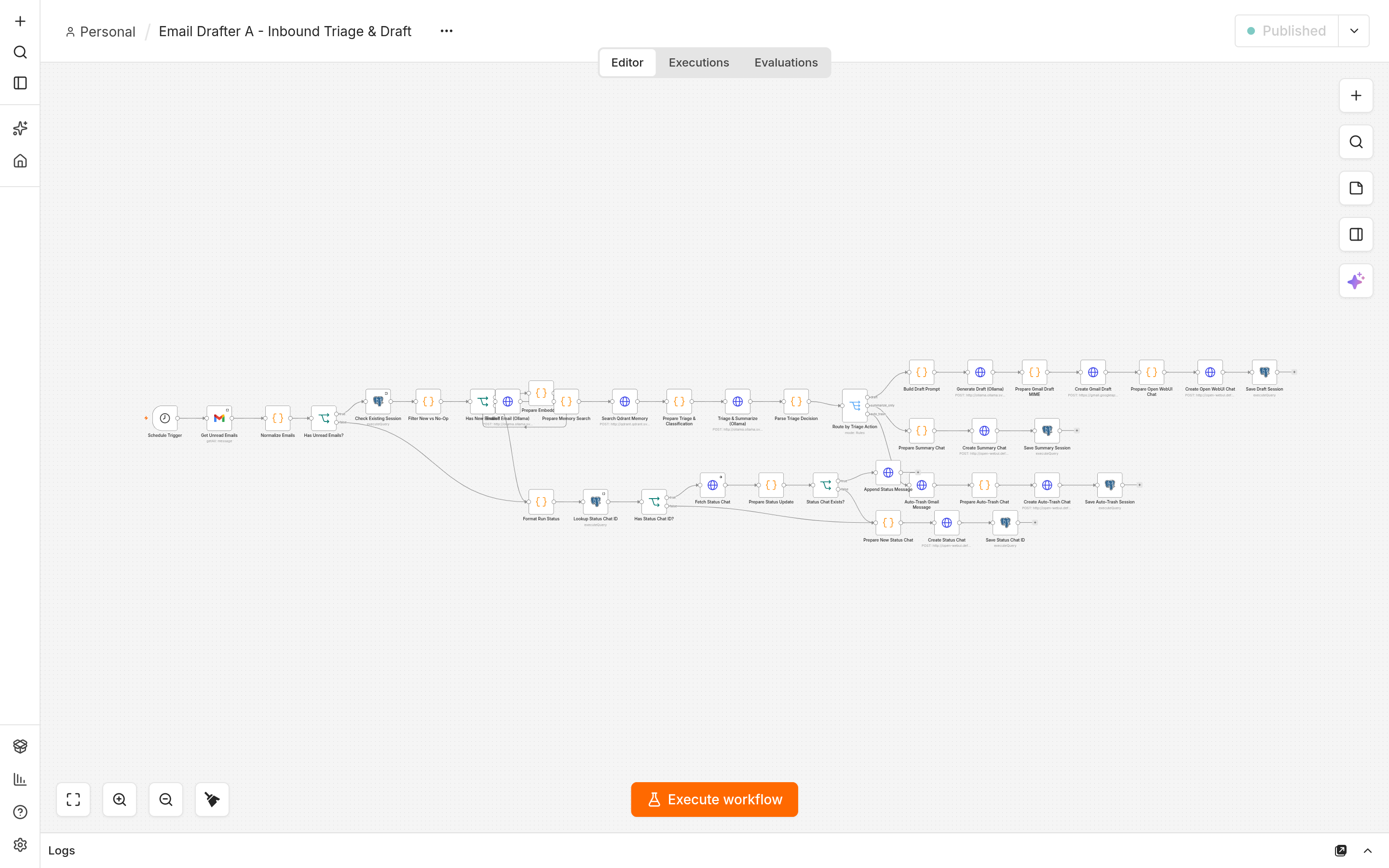
- Workflow A (
email-drafter-inbound, 39 nodes) — Inbound Triage, Drafting, & Heartbeat- Schedule Trigger (every 4 hours) → Get Unread Emails (
in:inbox is:unread -from:me,alwaysOutputData: true) → Normalize Emails (extracts sender, domain,List-Unsubscribe,no-replyhints). - Idempotency (
Check Existing Session→Filter New vs No-Op): Queriesemail_draft_sessionsand filters by exactgmail_message_id/ activegmail_thread_idsets (never by array index!). - If 0 new emails: Updates a single
Email Assistant — Run Statuschat in Open WebUI (tracked viaemail_assistant_meta, keeping the last 30 entries) with a timestamped✅heartbeat. - For each new email: Embeds with
nomic-embed-text:v1.5→ searches Qdrantemail_draft_memory(matchingsender_email,sender_domain,category,global) before triage →gemma4:12breturns JSON{ email_category, recommended_action, triage_reason, inbound_summary }with a code-level safety guard that blocksauto_trashunless an explicit learned triage rule exists. - Routes into 3 branches:
draft:gemma4:12bgenerates reply using matched style rules → Gmail RESTPOST /users/me/drafts→ Open WebUIDraft: ...chat → Postgres insert (DRAFTED).summarize_only: Skips drafting → Open WebUISummary [<category>]: ...chat → Postgres insert (ARCHIVED, empty draft ID).auto_trash: Gmail RESTPOST /users/me/messages/{id}/trash→ Open WebUIAuto-Trashed [<category>]: ...review chat → Postgres insert (ARCHIVED).
- Schedule Trigger (every 4 hours) → Get Unread Emails (
- Workflow B (
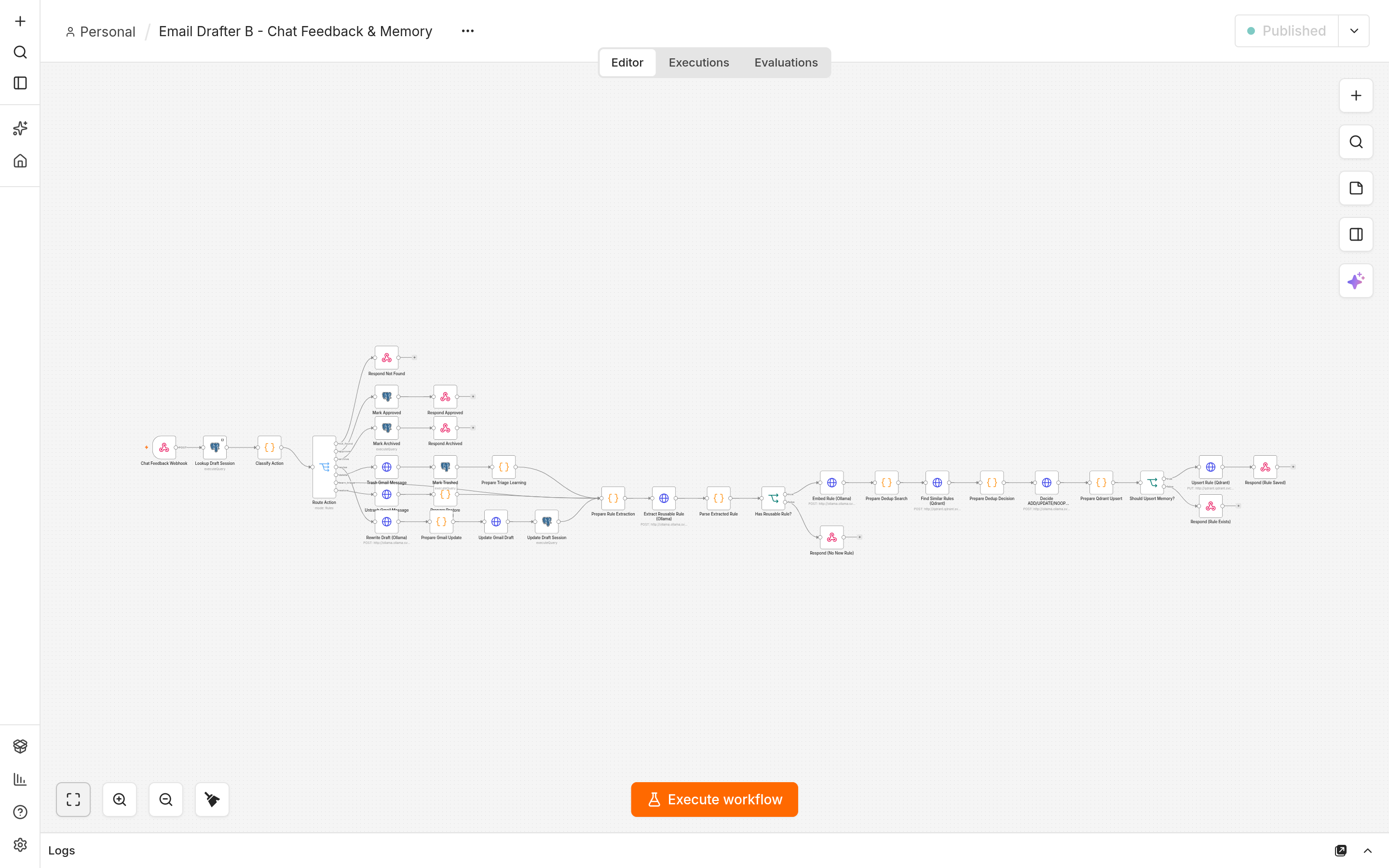
email-drafter-chat-feedback, 33 nodes) — Chat Feedback, In-Place Draft Rewrite, & Memory Learning- Webhook (
POST /webhook/email-draft-feedback) ← called by the Open WebUIemail_draft_assistantPipe. - Postgres Lookup by
openwebui_chat_idresolves the exactgmail_message_idandgmail_draft_id. - Action Router (
Switch):done/approve/lgtm→ marksAPPROVED_SENT(no LLM call).archive/ignore→ marksARCHIVED(no LLM call).delete/trash→ moves email to Gmail Trash (POST /messages/{id}/trash) + runs triage rule extraction on any guidance included afterdelete.restore/untrash→ recovers email from Gmail Trash (POST /messages/{id}/untrash) + updates the triage rule in Qdrant.- Summary-only chat feedback (
gmail_draft_id == '') → runs triage rule learning directly. - Draft revision feedback →
gemma4:12brewrites the draft → Gmail RESTPUT /users/me/drafts/{id}updates the existing draft in-place → updates Postgresrevision_count→ runs rule extraction.
- Memory Pipeline (
gemma4:12b+nomic-embed-text:v1.5+ Qdrant): Extracts only reusable style or triage rules (ignoring one-off edits like dates/times), embeds the rule, searches top-3 similar rules in Qdrant, asksgemma4:12bto chooseADD,UPDATE <existing_id>, orNOOP, upserts to Qdrant, and replies inline in Open WebUI.
- Webhook (
- Workflow C (
email-drafter-error-notifier, 3 nodes) — Failure Alerting- Linked via
"errorWorkflow": "email-drafter-error-notifier"in both Workflow A and Workflow B. Error Trigger→Format Error Chat→POST /api/v1/chats/newcreates a⚠️ ERROR: <Workflow> (<Failed Node>)chat in Open WebUI with the error message, stack top lines, timestamp, and direct execution link in n8n.
- Linked via
Verify Step 4
Verify the pod rollout, PostSync DB Job, imported workflows, credentials, tables, and cross-namespace connectivity from n8n:
> k get po,jobs -n n8n
NAME                             READY   STATUS      RESTARTS       AGE
pod/n8n-7c94c8c54c-ljgk5         1/1     Running     0              36s
pod/n8n-db-init-email-drafts-... 0/1     Completed   0              15s
pod/n8n-postgresql-0             1/1     Running     10 (33h ago)   59d

> k logs -n n8n deploy/n8n -c import-workflows
Preparing credentials (minting initial Gmail access_token from refresh_token)...
Importing credentials...
Successfully imported 3 credentials.
Importing workflows...
Successfully imported 3 workflows.

> k exec -n n8n n8n-postgresql-0 -- env PGPASSWORD=<db-password> psql -U n8n -d n8n \
  -c 'SELECT id, name, active FROM workflow_entity;' \
  -c 'SELECT id, name, type FROM credentials_entity;' \
  -c '\dt email*'
              id              |                   name                   | active
------------------------------+------------------------------------------+--------
 email-drafter-chat-feedback  | Email Drafter B - Chat Feedback & Memory | t
 email-drafter-inbound        | Email Drafter A - Inbound Triage & Draft | t
 email-drafter-error-notifier | Email Drafter C - Error Notifier         | f

         id         |      name      |      type
--------------------+----------------+----------------
 gmail-oauth-cred   | Gmail Account  | gmailOAuth2
 n8n-postgres-cred  | n8n PostgreSQL | postgres
 openwebui-api-cred | Open WebUI API | httpHeaderAuth

               List of relations
 Schema |         Name         | Type  | Owner
--------+----------------------+-------+-------
 public | email_assistant_meta | table | n8n
 public | email_draft_sessions | table | n8n
Finally, open https://n8nh.domain.com and Publish Workflow A and Workflow B (Workflow C runs automatically on errors without needing to be published).
Seeing It Work: End-to-End Examples
Example 1: Iterative Draft Feedback & Memory Recall
-
First email arrives from
user@fake.com(“How about lunch tomorrow?”):- Workflow A creates Gmail draft
r1234567890123456789and opens a chat titledDraft: How about lunch tomorrow? (user@fake.com)in Open WebUI.
- Workflow A creates Gmail draft
-
Giving mixed feedback in Open WebUI (a one-off scheduling detail + a reusable style rule):
“Suggest 12:30 PM at Main Street Cafe, and for emails from user@fake.com always keep replies casual, under 2 sentences, and sign off with ‘- A’.”
- Workflow B rewrites the draft for 12:30 PM at Main Street Cafe, updates the Gmail draft in-place, and stores only the reusable rule in Qdrant (dropping
"12:30 PM at Main Street Cafe").
- Workflow B rewrites the draft for 12:30 PM at Main Street Cafe, updates the Gmail draft in-place, and stores only the reusable rule in Qdrant (dropping
-
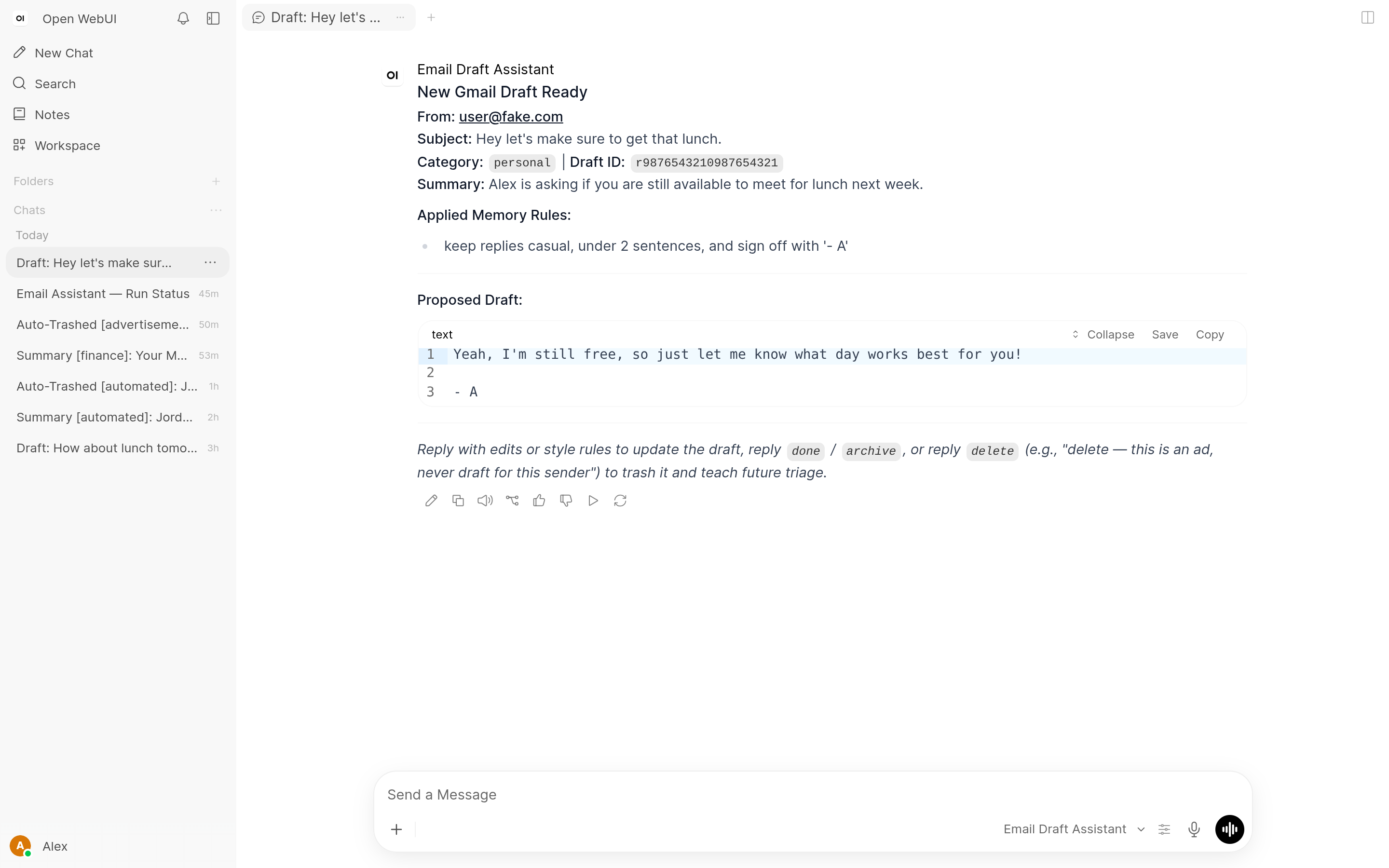
Second email arrives from the same sender (“Hey let’s make sure to get that lunch.”):
- Workflow A automatically retrieves the rule from Qdrant and produces the exact preferred tone and sign-off on the very first draft:
### New Gmail Draft Ready
**From:** user@fake.com
**Subject:** Hey let's make sure to get that lunch.
**Category:** `personal` | **Draft ID:** `r9876543210987654321`
**Summary:** Alex is asking if you are still available to meet for lunch next week.

**Applied Memory Rules:**
- keep replies casual, under 2 sentences, and sign off with '- A'

---
**Proposed Draft:**
---text
Yeah, I'm still free, so just let me know what day works best for you!

- A
---
Example 2: Content-Conditional Triage & Auto-Trash Review Chats
Not every email from a domain should be treated identically—for example, linkedin.com sends both noisy feed digests and important coworker/connection requests.
- When a LinkedIn feed digest arrived, Workflow A classified it as
automatedand opened aSummary [automated]chat (with no Gmail draft). -
In that chat, I replied with a conditional rule:
“delete — for linkedin.com emails, auto-delete feed digests, suggested posts, and promotional updates, but keep and summarize connection requests, coworker invitations, and direct messages.”
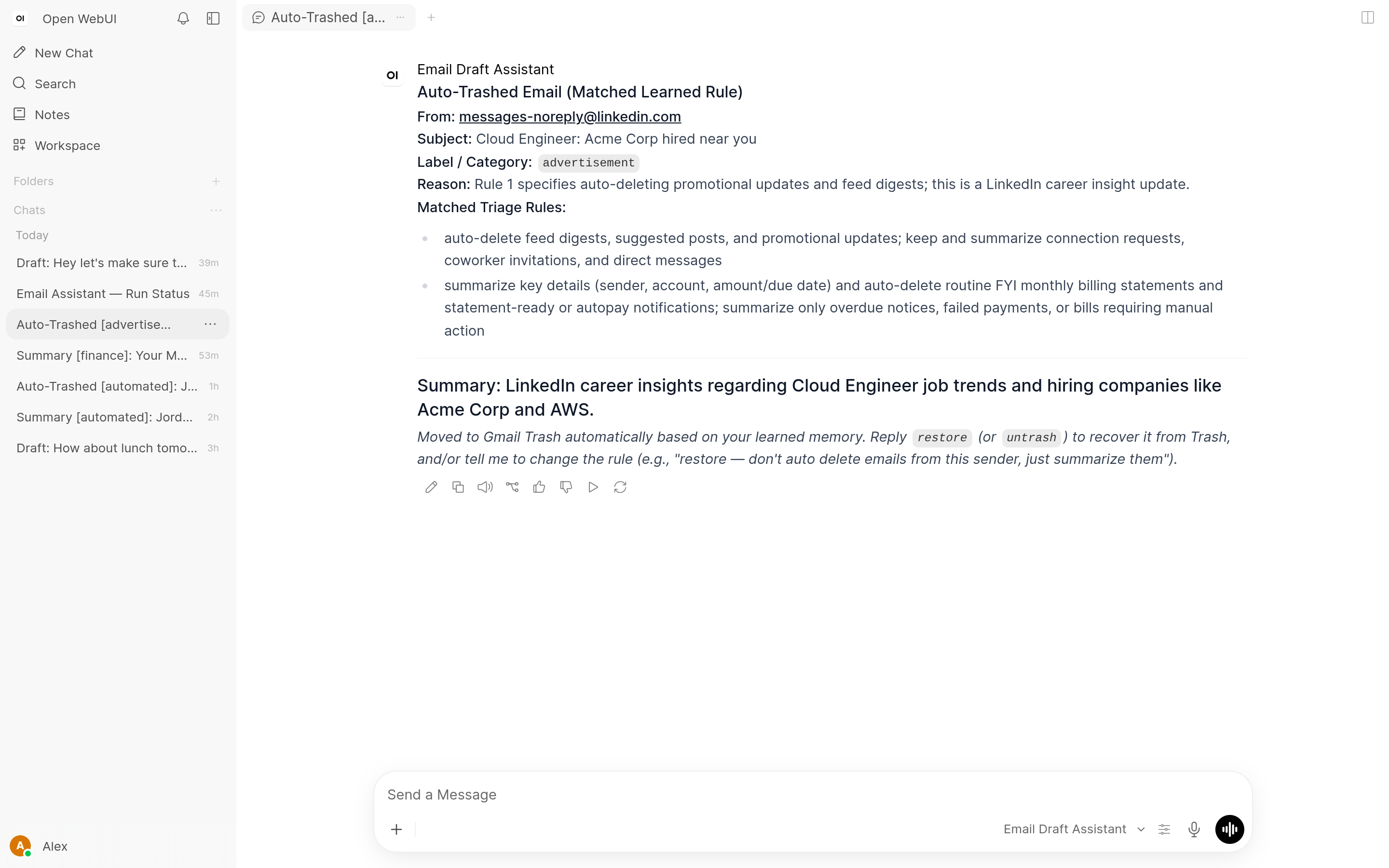
- When a subsequent LinkedIn career-insight promo arrived (
messages-noreply@linkedin.com), Workflow A matched the rule, moved it to Gmail Trash, and posted anAuto-Trashedreview card in Open WebUI:
### Auto-Trashed Email (Matched Learned Rule)
**From:** messages-noreply@linkedin.com
**Subject:**  Engineer: Acme Corp hired near you
**Label / Category:** `advertisement`
**Reason:** Rule 1 specifies auto-deleting promotional updates and feed digests; this is a LinkedIn career insight update.
**Matched Triage Rules:**
- auto-delete feed digests, suggested posts, and promotional updates; keep and summarize connection requests, coworker invitations, and direct messages
Similarly, a monthly billing email (ebill@billing.example.com — “Your Monthly Billing Statement is Ready”) landed as a Summary [finance] chat without creating a draft, where I taught a global rule to summarize and auto-delete routine FYI statements while keeping overdue/failed-payment alerts in my inbox.
Querying Qdrant confirms all three structured rules stored cleanly in email_draft_memory:
> k exec -n n8n deploy/n8n -- wget -qO- \
  --header="Content-Type: application/json" \
  --post-data='{"limit":10,"with_payload":true,"with_vector":false}' \
  http://qdrant.qdrant.svc.cluster.local:6333/collections/email_draft_memory/points/scroll | jq '.result.points[].payload'
{
  "rule": "keep replies casual, under 2 sentences, and sign off with '- A'",
  "scope": "sender",
  "category": "scheduling",
  "sender_email": "user@fake.com",
  "sender_domain": "fake.com"
}
{
  "rule": "auto-delete feed digests, suggested posts, and promotional updates; keep and summarize connection requests, coworker invitations, and direct messages",
  "rule_type": "triage",
  "action_policy": "auto_trash",
  "scope": "domain",
  "category": "automated",
  "sender_domain": "linkedin.com"
}
{
  "rule": "summarize key details (sender, account, amount/due date) and auto-delete routine FYI monthly billing statements and statement-ready or autopay notifications; summarize only overdue notices, failed payments, or bills requiring manual action",
  "rule_type": "triage",
  "action_policy": "auto_trash",
  "scope": "global",
  "category": "billing_statement"
}
Example 3: Heartbeat Run Log & Error Alerts
When the 4-hour cron completes with no new unread emails, Workflow A appends a single timestamped line to Email Assistant — Run Status (keeping the last 30 runs):
### Email Assistant — Run Status Log
_Automatic heartbeat when Workflow A completes with no new emails to process (last 30 runs kept)._

✅ **Nov 27, 2026, 10:28 PM (UTC):** Inbox check succeeded — **0 unread messages**.
Troubleshooting & Lessons Learned
A few real snags we hit and fixed along the way:
- n8n
Init:0/1FailedAttachVolumedeadlock: The communityn8nchart defaults tostrategy.type: RollingUpdate, which deadlocks on aReadWriteOnce(ceph-block) PVC because the new pod cannot mount the volume while the old pod is still running. Settingstrategy: { type: Recreate, rollingUpdate: null }fixed it permanently. Unable to sign without access tokenon importedgmailOAuth2credentials:@n8n/client-oauth2throws before sending a request ifoauthTokenData.access_tokenis empty, so n8n’s automatic401 → refresh_tokenflow never triggers. Minting an initialaccess_tokenfromrefresh_tokeninside theimport-workflowsinitContainer solved this cleanly.--activeState=fromJsonfails in single-instance n8n:n8n import:workflow --activeState=fromJsonis only supported in queue/multi-main mode. Dropping that flag and gating imports with a SHA-256 hash file on the PVC ensures normal pod restarts never unpublish workflows.- Open WebUI background follow-up tasks overwriting Gmail drafts: Right after receiving a reply from the Pipe, Open WebUI sent an internal
"### Task: Suggest 3-5 follow-up questions"request to the same Pipe model, which hit n8n and overwrote the Gmail draft with{"follow_ups": [...]}. Guarding on__task__/### Task:and makingpipeasync defwithasyncio.to_thread(...)fixed both the phantom webhook calls and Redis event-loop timeouts. - Multi-item Postgres
alwaysOutputData: trueindex shifting: When 2 unread emails enteredCheck Existing Session(one new with 0 DB rows, one existing with 1 DB row), Postgres dropped the 0-row item and output a 1-element array—shifting index1down to index0and causing the new email to be skipped. Matching Postgres results strictly by key (Setofgmail_message_idand activegmail_thread_id) instead of array index eliminated the bug completely. - Kustomize ConfigMap hash rewrites with Helm charts: Removing
disableNameSuffixHash: truealone wasn’t enough for Kustomize to rewriteDeployment/n8n’sworkflowsvolume reference because the Helm chart omitsmetadata.namespaceon the Deployment. Commenting outnamespace: n8non then8n-workflowsconfigMapGeneratoraligned the namespaces so Kustomize rewrites the Deployment automatically and triggers rollouts only when a workflow JSON changes.